Monday, December 14, 2009

Traffic Stats

This my last blog with lots of stats, I promise. I just find stats a lot more convincing than listening to somebody speculate. It takes almost no effort to speculate but to collect the stats takes lots of effort. If your going to believe someone, believe the one who spent some effort putting together their argument.

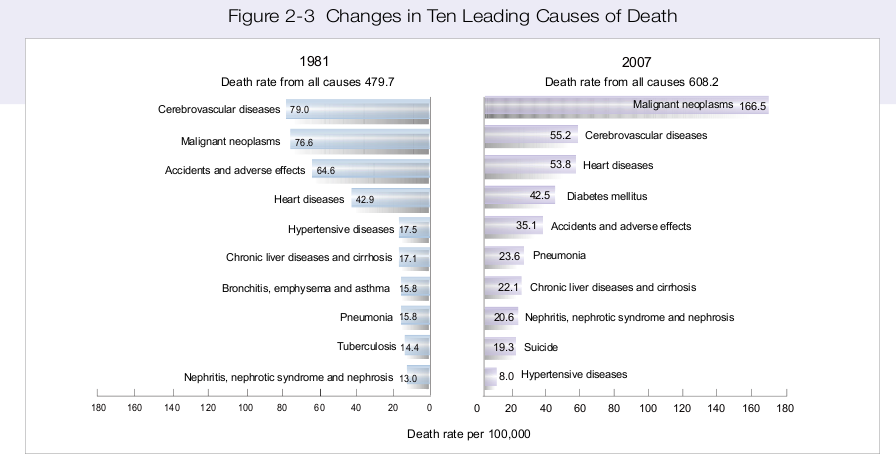
This chart, to me, documents the charge of Taiwan from a developing country to a developed country. From 1981 to 2007, stroke is replaced as the major killer by cancer. Cancer is probably the leading cause of death in all developed countries.
Accidents go down and lifestyle/environmental diseases go up.


My personal time in Tainan leads me to think that accidents are a major killer but the stats prove me wrong. And the accident mortality rate is actually down! One data point(my experience) doesn't determine a trend.

Taiwan has a large fishing industry, fishing has always been a dangerous profession. That's why there are so many drowning/submersions in the stats below.


The next 3 tables are from a report by Professor Cheng-Min Feng at National Chiao-Tung University in HsinChu.

As this table below shows, as the number of vehicles increased the number of fatalities decreased, so you might argue that drivers are becoming better. (No, I wouldn't go that far.) Accidents and injures go up with the number of cars, why do fatalities go down?

Helmet laws, better Emergency Response, more mass transit, ... It's hard to say.

I like the stats that most causes are the driver. Duh!


So what form a transportation is safest. The injury rate for motorcyclist is staggering compared to the number of accidents. "Momma don't let your babies growup to be motorcyclists."


But of course it is exact the young, the new drivers that ride motorcycles and they are the ones die early. As seen in the table below.


Friday, December 11, 2009

Good Graffiti

I think Tainan is like any big city, they've decided that graffiti is just a fact of life and they just have to deal with it. In the photo below I think they put in sewer pipes in a railway underpass but they didn't even bother to clean up the graffiti before installing the pipes. Every big city has graffiti so what's the point of trying to clean it up. The money could be spent better somewhere else.


Recently the Chemistry Department on the NCKU department painted their ventilation facilities. To me it looks a lot like the graffitti around the town. Maybe it's just the acrylic paint colors.


I definitely see a connection between the  graffitti in the tunnels and what the Chemistry Department used.


Even the Mathematics Department got the bug, here is a empty wall on the Mathematics Department building. It has a 3D effect so I'm sure it wasn't done by mathematician but by an artist.


Most store fronts in Taiwan on the street level have a metal sliding door front. A perfect empty space for artistic expression. The store below is a sea food restaurant. They must have contracted with an artist to fill this empty space. I definitely see a similarity between the graffiti in the tunnels and this store front.


In the business mode the metal door goes up and business is in order.


Wednesday, December 9, 2009

Newspapers

People often ask me, they say: "Mike how do you keep so well informed of what's happening in the US?" (Actually no one has ever asked me this question.)  Here in Taiwan there are newspapers, radio, TV and the internet.

Newspapers

We have two daily newspapers published in English. The "Taipei Times" is the paper sympathetic to the DPP, the Taiwanese Independence Party. The other, older paper is the "China Post", they are more sympathetic to the KMT, the China Nationalist Party. I usually go with the the "Taipei Times" but sometimes they are sold out and I have to buy the "China Post". They are both good papers for the expatriate community and they cover the US scene and actually cover world news better than say the Seattle local papers. Both are always 20 pages in length!
Everyday I read one or the other, both cost 15 NT($.50US) and are sold at the 711s or mini marts. They both sometimes have feature stories in both English and Chinese for those learning one language or the other. Here's a big story from some time ago.


 On the same day as above the "China Post" appeared as:


'The China Post use to have a daily bridge column but that was replaced with a sudoku column.

Radio

There is one English radio station in Taiwan, ICRT. It plays pop music but some of the programs at night on the weekends are good. It has hourly news broadcasts that are good too. Also traffic Taipei traffic reports. They have a half hour of BBC news from 7AM to 7:30. I use this as my alarm in the money. Even though it's the BBC, most of the airtime is given to what those crazy Americans are doing.

I also have my short wave radio with me, even on the first floor of the dorm I can listened to VOA, BBC, Radio China, Japan, Russia, Germany, ...

TV

In my dorm we have cable with about 100 channels. The channels in English are:
CNN, BBC, Discovery, National Geographic, Travel, and some movies in English with Chinese subtitles.

Internet

Because at one time or another I subscribed to the

New York Times
Seattle Times
Seattle Post Intelligencer

I have internet access to their websites and they send me daily web alerts of breaking stories as well as summaries of daily events. I keep up with with the comic strips:

Dilbert
Chickweed
Bizzaro

And of course I listen to NPR on line and have access to their website.

Like everyone else I have too many options and not enough time.

Monday, December 7, 2009

Good ideas II

I keep a folder of photos that just come up as I'm walking the streets of Tainan that seem like good ideas I don't see in the US. Here we have a bus that carries around a tent that can be used to cover itself from the sun. This is better than running the motor to run the AC while the bus is waiting for the passengers to come back.


Well if solar power is going to work anywhere it has got to be Taiwan. Here is the water heating apparatus on a dorm at NCKU. I heard that in Florida there use to be such water heating methods but it was easier for the landlord to charge for electricity than to maintain such a passive system. Cooperation has to benefit both sides to be something that both sides cooperate on.


In the 70s, I read a book the "The Zen and Art of Motorcycle Maintence" and I actually belonged to a book discussion club at the UM with Pirsig(the author) about this book. The gist of this book, as remember it, was that even though the driver took his kid on a cross country motorcycle trip, the driver didn't understand that the kid didn't appreciate the trip like he did because the kid's viewpoint as a passenger wasn't the same as the driver. Duh! From behind the driver you don't see what the driver sees! Duh! Duh! Duh! In Taiwan they have figured this out and the kid is up in front! With a bamboo addition:


Or for a more structured solution(double seats):


One of the most annoying thing about living in downtown Bellevue is the leaf blowers that start up at 7AM. I thought maybe the high price of gas might mitigate the leaf blowing but no such luck. Early in the morning in Bellevue the leaf blowers go full blast, sleeping in with the windows open is not an option.

In Tainan they have the same leaf problem but they don't use leaf blowers. Lots of old people are employed to do the same job, they use the old fashion way of brooms. Here is a station of one of the NCKU workers who sweep in the mornings. Exercise for old people and a clean environment, win-win.


Sunday, December 6, 2009

Koxinga, the KMT and 228

There is a curious addition to the Koxinga shrine that I wrote about first on
11/16/09. There is a ceremonial arch to one of the entrances to the Koxinga Shrine and recently (2006) there was an explanatory plaque put up next to this arch.


The cross member of the arch has the symbol(the circle with 12 outward pointing triangles) of the KMT, the Chinese Nationalist Party. An additional plaque describes why this is a controversial arch and why it is still up. Here is the plaque in Chinese, English and Japanese.


Let me summarise the story.  In 1945, after the defeat of Japan, the Chiang Kai-Shek's KMT was locked in a battle with the Mao' s Communists  for all of China. Taiwan had be repatriated to Chiang's KMT at the end of WWII. When Chiang's force took control of Taiwan there was an uneasy truce. The refugees from the mainland felt they were weaken by fighting the Japanese in WWII and this allowed the Communists to fight on. The Taiwanese had lived for 50 years as a Japanese colony and had been abandon by the Chinese in 1895, many Taiwanese had fought on the Japanese side in WWII.

This was a tense situation, the Chinese blamed the native Taiwanese for their losing on the mainland and some Taiwanese longed for the rule of law under the Japanese. The spark that set off a massacre happened in February 28th(228), 1947. An incident over a woman street vendor selling cigarettes and a Chinese tax official lead to protests from the Taiwanese in Taipei.  The Chinese Garrison  overreacted and the killing of unarmed civilians began. The Taiwanese began an open rebellion that was put down by the Chinese military. Then started the KMT's "White Terror" campaign in which maybe 30 thousand Taiwanese were killed. Many of those targeted had more than a high school education or had spoken out. They became a lost generation of Taiwanese intellectuals.

Here is the text of the plaque placed next to the KMT arch:

Start:

In 1947, the Chinese Minister of Defense General Pai Chung-Shi was sent to
Taiwan to deal with the "228 Incident". Sparked by the the seizure of smuggled
tobacco in Taipei, the "incident" became an island-wide conflict between the
Taiwanese and soldiers from mainland China, resulting in a bloody military
crackdown and thousands of civilian deaths. Taiwan was in a turmoil. When
General Pai passed through Tainan, he scarificed to Koxinga, erected a monument archway and inscribed the following couplets:

"The desolate minister grasped his desolate royalty, the magnanimity filled
everywhere and forever. The just man held in justness; do not take the
achievement to evaluate a hero".

And on the arch inscribed

"Having good faith, virtue and patriotism".

However the existent text was the revised edition by a historian. In recent
years, the KMT party emblem was thought to taint the site and some suggested
that it should be removed. However, the past serves as a warning to future
generations and it was decided that the emblem should remain as an important
element of history of those tragic times. Erected by the Committee of
Historical Documents of Tainan City Government in 2006 May.


:End

The English is a little rough but the intent is clear. It's an example of whoever is in power using the symbols of the past to justify there own actions.

There's an even more recent controversy about the Koxinga Shrine. Taiwan and mainland China are now in negociations over "Cross Straits Normalization" between the two countries.(Of course, mainland China still doesn't admit that Taiwan is a country!) Anyway the mainland Chinese negociator came to Tainan and also visited the Koxinga shrine. For the same reasons that any politician visits the Koxinga Shrine.

In Tainan, which is an anti KMT, anti mainland China area, a shoving match broke out between local a DPP politician and the mainland official. Charges from that fight are moving through the Taiwan court system now. Of course if this had happened in the mainland the local official would probably have been shot by now.

So Koxinga has been claimed as a hero by the Qing, the Japanese, the KMT, the mainland Chinese. Who will be next?
Doorsteps

One pervasive difference between the US and Taiwan is that rooms in Taiwan are separated by a doorstep that is raised above the level of the two rooms on either side of the door. There are not too many carpeted rooms in Taiwan, as the humidity is too high and the carpet would just be a environment for fungus, mold, all kind of growths. So tiles are the way to go, they can be easily mopped. With the raised member at the door entrance mopping the room or mopping the hall is two separate operations.  There is a separation of responsibilities, the public and the private.


So if you are not careful in moving from room to room you stumble  over the doorstep. The doorsteps at the historical sites are the tallest, sometimes as big as 8 inches. Here we are at the Chilkan Shrine, I think there is some cultural background behind this difference, but I've never heard it explained.


I remember there was a study in the US about the how often old people got hip fractures as a function of the step up they had to make to take a shower. There was a direct statistical correlation between the number of hip fractures and the height of the step up into the shower. Of course taking a shower in a bathtub is the most problematic. It seems we all think our own situation is different but statistics makes each of us an incident waiting to happen.


Even the most modern buildings have this have this vertical separation between rooms. Eventually you get use to thinking "step up".  So the mopping routine works it way into how you think about the mundane event of just moving from room to room. 

Accident

As a big walker in Tainan, it was just a matter of time before I saw a traffic accident. Actually I think I saw the end of an accident some time ago, I came across an old man being cared for by two policeman. I speculate that he was knocked down by a hit and run motorcycle and the police were helping him get adjusted. The possibility of catching the perpetrator were nil. The police knew this they just wanted to ease the old man into the reality of the situation.


But recently, I saw the results of an accident before the ambulance/police arrived.
At the Western Gate on Dongmen road the traffic goes around the gate like a traffic circle. There seems to be three lanes about the gate, so negotiating the traffic circle means merging between lanes. Merging doesn't work if you don't look back and motorcyclists rarely use the rear view mirror let alone twist their head and look back. Here two motorcycles are down and so are the motorcyclists maybe they just knocked each other down.


One of the motorcyclists, the one in the red helmet, gets up and hobbles aways.


The other downed motorcyclists waits for the ambulance to take him away. From the way the ambulance workers treated him it looked like he maybe broke a collarbone or an arm. The first ambulance got the action, two other ambulances came by, with "first come first serve" and so they just kept moving.


The police arrived after the ambulances and commenced to  direct traffic around the two down motorcycles. Both the ambulance people and police seemed very professional, like they were handling an everyday situation.

For me it put a personal impression on what I thought happened often. Now when I heard the ambulance siren I think about the two men lying on the road. It's means somebody is hurting bad maybe more than a trip to hospital can fix. It's not academic, I see a face grimancing in pain.

A few days later I saw another 2 motorcycles down. Some of the smaller alleys aren't wide enough for cars but 2 lanes of motocycles share the alley with walkers and bicycles. In this accident both women seem OK, they were making calls on their cell phones.


This is an update on 11/28, in the pass two days I have seen the results of two more accidents with motorcycles. In both cases the ambulance took one rider away. Now everytime I hear the ambulance siren I think of these accidents. This one was on Siaodong Road a few blocks from school. A motorcycle hit a car, probably a car making a left hand turn and the motorcycle going straight.


This morning I saw another accident this one between two motorcyclists. One ambulance and 3 police cars. It looked like one of the cyclists had broken bones.


I was thinking about renting a motorcycle during the break between classes but I think now I'll just ride all the bus routes in Tainan instead.